What am I looking at?
The Sun always lights exactly half of the Moon. What we call a phase is simply how much of that lit half happens to be turned toward Earth. When the lit half faces us we call it full; when it faces away we call it new.
The Moon is tidally locked, so the same side faces Earth. But “the same side” is not exact. The Moon’s orbit is an ellipse, so it speeds up and slows down while its rotation stays even, and it rocks east and west. Its axis is tilted to its orbit, so it also nods north and south. Astronomers call this libration, and it is why the edges of the Moon slowly turn toward us and away again.
Add all of that up over months and Earth gets to see meaningfully more than half of the lunar surface. The commonly quoted figure is about 59%. You can compute it yourself in the second act, or in Advanced, and watch the number arrive.
The Moon has almost no atmosphere, so there is no glow around its edge and no blue haze. The terrain looks most dramatic near the terminator, the line between day and night, because that is where the Sun is low and the shadows are long.
How this is built
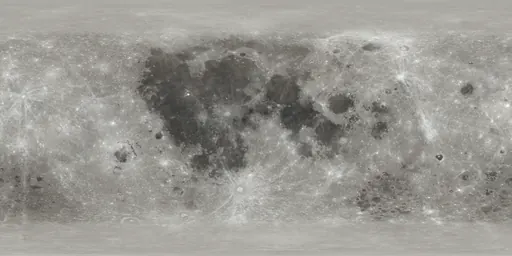
The surface is NASA imagery, not an illustration: colour from the Lunar Reconnaissance Orbiter’s Wide Angle Camera, and relief from the Lunar Orbiter Laser Altimeter. Positions, phase and libration come from Astronomy Engine using IAU rotation elements. The terminator is not painted on; it is where the real sunlight direction stops reaching the surface. The Moon’s mesh never rotates — it is the Moon’s body-fixed frame, and the camera and the sunlight move around it, which is why this cannot double-count the Moon’s rotation.
The stars behind the Moon and the faint band of light are art direction rendered through a wide observing field, composited behind the telescope view. They are not a star catalogue and nothing scientific is derived from them. The music is generated in the browser as you listen; there is no audio file and no network request.
Lunar surface imagery: NASA’s Scientific Visualization Studio. This project is not endorsed by NASA.